
I will discuss here a ḥadītḥ that represents a miracle of the Prophet Muhammad (PBUH). This remarkable prophecy is immensely significant, both historically and creedally. In this ḥadīth, the Prophet (PBUH) foretold that the Companion ʿAmmār Ibn Yāsir would be killed by “the transgressor group” (al-fiʾa al-bāghiya). The word bāghiya means “transgressor,” “aggressor,” “unjust,” “tyrant,” and so on. I will translate it here as “transgressor”.
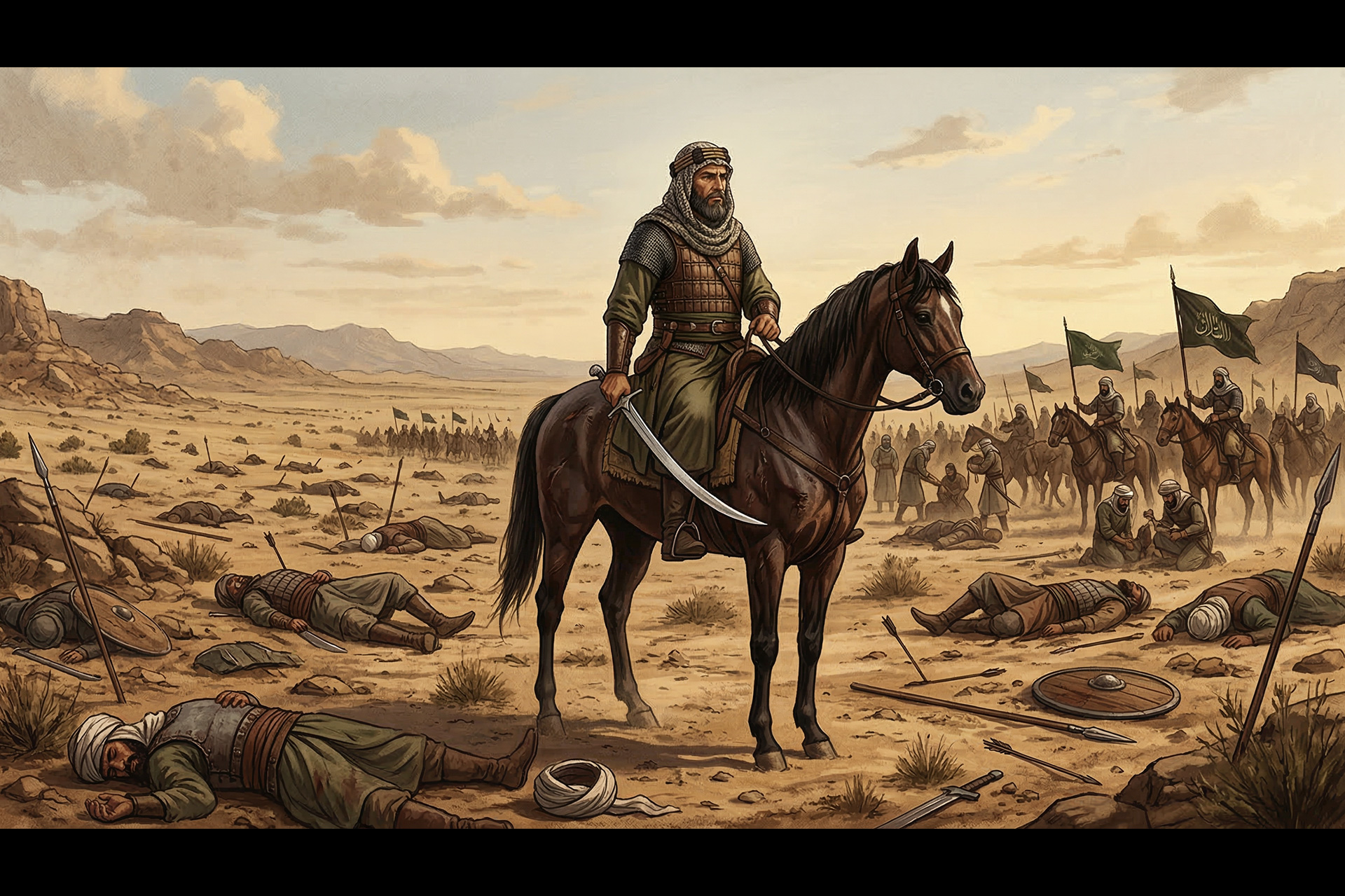
ʿAmmār was martyred in the Battle of Ṣiffīn during the caliphate of ʿAlī Ibn Abī Ṭālib. He fought in the army of the legitimate Caliph against the rebel Muʿāwiya Ibn Abī Sufyān and his forces.[1]
1 The History of the Family of Yāsir
ʿAmmār’s father, Yāsir, migrated from Yemen to Mecca in search of his brother. He never returned to Yemen and remained in Mecca, where he entered into a pact with a man from the Banū Makhzūm tribe. In this context, a “pact-holder” (ḥalīf) was a man who sought the protection of a tribe he did not belong to. He lived among them but did not have the same status or rights as their own tribesmen. However, a pact-holder was a free man, not a slave.
The man who gave Yāsir protection had a female slave named Sumayya, whom he married to Yāsir. From this union, ʿAmmār was born. Allah had destined him to become one of the most distinguished Companions of the Prophet (PBUH) and one of the most sincere in his devotion to Islam, both during the Prophet’s lifetime and afterwards.
ʿAmmār, his brother ʿAbd Allāh, and their parents were among the first to believe in the message of the Prophet (PBUH) and among the first to openly declare their conversion to Islam. However, because the family of Yāsir were only pact-holders in Mecca, they had no kin to defend them from the persecution of the Quraysh. They were tortured in the searing heat of Mecca.
When the Prophet (PBUH) passed by ʿAmmār and his family while they were being tortured, he said, “Have patience, O family of Yāsir, for your promised meeting is in Paradise”.[2] Sumayya was killed by Abū Jahl, becoming the first martyr in Islam. There are prophetic ḥādīths that praise ʿAmmār’s virtues.
2 The Prophecy in Muslim and al-Bukhārī
Muslim narrated the ḥadīth through Abū Saʿīd al-Khudrī, “Woe to the son of Sumayya! A transgressor group will kill you.”[3] He also mentioned it through Umm Salama, the Prophet’s wife. According to her, the Messenger of Allah (PBUH) said to ʿAmmār, “The transgressor group will kill you.”[4]
Al-Bukhārī narrated the ḥadīth through Abū Saʿīd al-Khudrī in the following wording, “Woe to ʿAmmār! The transgressor group will kill him. He calls them to Paradise, and they call him to the Fire.”[5] He also recorded a very similar version, “Woe to ʿAmmār! The transgressor group will kill him. ʿAmmār calls them to Allah, and they call him to the Fire.”[6]
There has been a suggestion by some that the phrase “The transgressor group will kill him” was added to the ḥadīth in al-Bukhārī’s manuscripts later by some copyists, or that al-Bukhārī later changed his mind and decided that this phrase was not authentic. This desperate attempt to deprive this Prophetic prophecy of its historical and creedal significance is rejected on multiple grounds, including the fact that this claim was first reported as late as the 5th century, i.e., two centuries after the time of al-Bukhārī. It represents an attempt to deny that the Prophet forewarned that Muʿāwiya Ibn Abī Sufyān would be a transgressor in his bid to seize political leadership, thereby indirectly instructing Muslims to support the legitimate caliph, ʿAlī Ibn Abī Ṭālib, in the ensuing conflict. Even Ibn Taymiyya—who praises Muʿāwiya’s character and rule—after noting that many copies of al-Bukhārī’s compilation do not have the critical phrase, goes on to state, “The scholars of Ḥadīth do not disagree that this addition is part of the ḥadīth.”[7] Accepting that Muʿāwiya led the transgressor group while at the same time revering him is not confined to Ibn Taymiyya but is a common contradiction among Sunni scholars.
Another sectarian and politically-driven attempt to deny the ḥadīth its meaning and significance is to identify “the transgressor group” with a group other than Muʿāwiya’s army. One such attempt is the claim that “the transgressor group” is the polytheists who tortured ʿAmmār in Mecca before the migration,[8] even though the ḥadīth is clearly a future prophecy. Another equally absurd view identifies “the transgressor group” with the Khawārij, but the latter appeared after the Battle of Sīffīn, in which ʿAmmar was killed, as critically noted by Ibn Ḥajar (852/1449).[9]
After discussing the absence of the critical phrase from some manuscripts of the al-Bukhārī, Ibn Ḥajar notes that numerous Companions narrated the ḥadīth in full. He confirms the authenticity of the ḥadīth and says, “In this ḥadīth, there is a sign among the signs of Prophethood, a manifest virtue for ʿAlī and ʿAmmār, and response to nawāṣib,[10] who claim that ʿAlī was not in the right in his wars.”[11]
3 A Widely Transmitted Ḥadīth
This ḥadīth is not found only in the collections of al-Bukhārī and Muslim, nor are Umm Salama and Abū Saʿīd al-Khudrī its only narrators. It is, in fact, one of the most widely narrated and transmitted ḥādīths (mutawātir). Companions who narrated it include:
- Umm Salama, the Prophet’s wife
- Anas Ibn Mālik, the Prophet’s servant
- Abū Rāfiʿ, the Prophet’s freed slave
- Abū Saʿīd al-Khudrī
- Abū Hurayra
- Hudhayfa Ibn al-Yamān
- Abū Ayyūb al-Anṣārī
- ʿUthmān Ibn ʿAffān
- Qatāda Ibn al-Nuʿmān
- Khuzayma Ibn Thābit al-Anṣārī
- Abū al-Yasar Kaʿb Ibn ʿAmr al-Anṣārī
- Abū Masʿūd al-Anṣārī
- ʿAmr Ibn Ḥazm Ibn Zayd al-Anṣārī
- ʿAmmār Ibn Yāsir
The ḥadīth was also narrated by ʿAmr Ibn al-ʿĀṣ and his son ʿAbd Allāh, who were part of “the transgressor group” as they fought in Muʿāwiya’s army. It is highly unlikely they would have fabricated a ḥadīth that so severely condemns them.
Furthermore, Muʿāwiya Ibn Abī Sufyān did not deny this ḥadīth when ʿAmr Ibn al-ʿĀṣ mentioned it in front of him after ʿAmmār’s martyrdom.[12]
Unsurprisingly for a ḥadīth narrated through so many different routes, it is cited in numerous collections, including:
- Muslim, al-Ṣaḥīḥ
- Al-Bukhārī, al-Ṣaḥīḥ
- Al-Tirmidhī, al-Jāmiʿ
- Al-Nasāʾī, al-Sunan al-kubrā
- Al-Bayhaqī, al-Sunan al-kubrā
- Aḥmad Ibn Ḥanbal, al-Musnad
- ʿAbd al-Razzāq al-Ṣanʿānī, al-Muṣannaf
- Ibn Abī Shayba, al-Muṣannaf
- Abū Yaʿlā, al-Musnad
- Al-Ṭabarānī, al-Muʿjam al-kabīr
- Ibn al-Jaʿd, al-Musnad
- Al-Ḥārith Ibn Abī Usāma, al-Musnad
Consequently, those who suggest that the phrase “the transgressor group will kill him” is inauthentic—based solely on its absence from certain manuscripts of al-Bukhārī’s collection—effectively reject the significance of the phrase being mutawātir. They would not apply such logic to any other ḥadīth possessing this level of multiple reporting. Their untenable position is clearly driven by sectarian interests.
4 The Miraculousness of the Ḥadīth
The ḥadīth about ʿAmmār’s death at the hands of a transgressor group is a miracle of the Prophet (PBUH) because it is a fulfilled prophecy about a future event. There are three miraculous aspects to this prophecy:
- ʿAmmār would die as a martyr.
- His martyrdom would be at the hands of a transgressor group of Muslims, not idolaters.
- This scenario was highly implausible at the time the prophecy was uttered.
4.1 The Martyrdom of ʿAmmār
The Prophet (PBUH) spoke this ḥadīth during the construction of the Prophet’s Mosque in Medina. At the time, each Muslim would carry one brick at a time, but ʿAmmār would enthusiastically carry two.[13] Some sources mention that ʿAmmār was recovering from an illness during the construction, which shows his love for Islam and the Prophet (PBUH) and his dedication. When the Prophet (PBUH) saw him overexerting himself by carrying the bricks, he brushed the dust off him and said, “Woe to ʿAmmār! The transgressor group will kill him. He calls them to Paradise, and they call him to the Fire.”
The construction of the Mosque was one of the Prophet’s first actions in Medina, so it took place in the first year of the Hijra. ʿAmmār was martyred in the Battle of Ṣiffīn in the year 37 H, so the Prophet foretold his death 36 years before it happened.
There is a lovely subtlety I would like to highlight here. The name ʿAmmār is a hyperbole of “ʿāmir,” which means “builder.” This makes ʿAmmār’s name a perfect fit, as he became an enthusiastic builder of the Prophet’s Mosque. Of course, when his parents named him ʿAmmār, they were simply choosing a name they liked. Yet in Allah’s foreknowledge, it foretold his illustrious future and an event that would lead the Prophet to utter an immensely significant ḥadīth.
It appears the Prophet (PBUH) mentioned this ḥadīth on more than one occasion, which explains why it was narrated by so many Companions. For example, it is reported that when the Prophet (PBUH) saw ʿAmmār on the day the trench was dug in the fifth year of Hijra, he said, “Woe to the son of Sumayya! A transgressor group will kill you.”[14] The Prophet (PBUH) would have likely repeated this ḥadīth due to its great significance.
So, this ḥadīth foretold the events it described by more than three and a half decades.
4.2 The Second Miraculous Aspect
After the martyrdom of Caliph ʿUthmān Ibn ʿAffān in 35 AH, Muslims pledged their allegiance to ʿAlī Ibn Abī Ṭālib as the new caliph. Among the governors he ordered be replaced was Muʿāwiya Ibn Abī Sufyān, the governor of Syria. However, Muʿāwiya refused to pledge allegiance to ʿAlī until he avenged ʿUthmān’s death. He demanded that ʿAlī either enable him to kill ʿUthmān’s killers or hand them over, as Muʿāwiya was from the same clan, Banū Umayya, as Caliph ʿUthmān.
ʿAlī refused this demand for several reasons related to the complex circumstances of the killing of ʿUthmān, which are outside our current subject. A major reason was that any attempt to seek vengeance at that time would have plunged the Muslims into a cycle of bloodshed far worse than the tribulation of ʿUthmān’s assassination. ʿAlī knew, as numerous Companions did, that Muʿāwiya’s demand was nothing more than a pretext to justify his refusal to recognise ʿAlī as the legitimate caliph, and consequently, he refused to accept his dismissal from the governorship. He would not relinquish the position of power and wealth he had cultivated over twenty years—a position that would serve as the launch pad for his longstanding ambition to seize leadership of the Islamic state.
The falsehood of Muʿāwiya’s claim was confirmed when he seized power six years later, as he did not avenge the martyrdom of ʿUthmān. Indeed, when ʿUthmān’s daughter, ʿĀʾīsha, reminded him of his pledge to avenge her father, he dismissed the request as being unrealistic, citing that the people had pledged allegiance to him only in exchange for a promise of safety.[15] He simply exploited the assassination of Caliph ʿŪthmān as a pretext to advance his political ambitions, both before and after appointing himself “the first of the kings,” as he described himself.[16]
Muʿāwiya’s refusal to accept the caliphate of ʿAlī led to the Battle of Ṣiffīn, a confrontation between the army of the legitimate caliph and the rebellious forces of the dismissed governor of Syria. ʿAmmār was in the army of ʿAlī, alongside dozens of those who fought with the Prophet in Badr, as well as many other Muslims. When ʿAmmār felt that his martyrdom was near, he asked for a cup of milk, drank it, and said that the Messenger of Allah (PBUH) had told him that it would be his last provision in this world.[17] Indeed, ʿAmmār was martyred in this battle while fighting against Muʿāwiya’s army.
With the exception of a small, dissenting faction, the vast majority of Muslims at the time and over the centuries have agreed that the army of the caliph was in the right while Muʿāwiya’s army was in the wrong. Muslim scholars, including those who see Muʿāwiya as a noble Companion, believe that the term transgressor group in the following Qur’anic verse applies to the rebellious Muʿāwiya and his army for fighting against the caliph and the state army:
وَإِن طَائِفَتَانِ مِنَ الْمُؤْمِنِينَ اقْتَتَلُوا فَأَصْلِحُوا بَيْنَهُمَا ۖ فَإِن بَغَتْ إِحْدَاهُمَا عَلَى الْأُخْرَىٰ فَقَاتِلُوا الَّتِي تَبْغِي حَتَّىٰ تَفِيءَ إِلَىٰ أَمْرِ اللَّهِ ۚ فَإِن فَاءَتْ فَأَصْلِحُوا بَيْنَهُمَا بِالْعَدْلِ وَأَقْسِطُوا ۖ إِنَّ اللَّهَ يُحِبُّ الْمُقْسِطِينَ.
And if two groups of believers should fight each other, then make peace between them. But if one of them transgresses (baghat) against the other, then fight against the one that transgresses (tabghī) until it returns to the ordinance of Allah. If it returns, then make peace between them with justice and act with justice. Indeed, Allah loves those who act with justice (Qur’an, al-Ḥujurāt 49:9).
Thus, the killing of ʿAmmār Ibn Yāsir at the hands of Muslim transgressors, rather than non-Muslim enemies, was a confirmation of the Prophet’s (PBUH) prophecy.
4.3 The Third Miraculous Aspect
When the Prophet (PBUH) said that ʿAmmār would be killed by a transgressor group, the idea of Muslims fighting each other in a civil war was unimaginable. At that time, the Muslims were a small, weak community surrounded by many powerful enemy groups. If someone thought that a Muslim would be killed, the logical conclusion would be that the killer would be an idolater, or perhaps an enemy from the People of the Book. It would never have occurred to a Muslim to imagine his death in a civil war between two Muslim armies. Such an event could only happen when Muslims were numerous and strong, and a major dispute had erupted among them, leading to armed conflict—a situation the small, weak Muslim community was so far from.
5 The Use of “Group” Instead of “Faction”
I would also like to draw attention to an interesting subtlety. In verse 49:9, the word ṭāʾifa (faction) is used with the verb for transgression (baghā), while the ḥadīth uses the word fiʾa (group). Although the word fiʾa appears eleven times in the Qur’an, it is never used in conjunction with the verb baghā.
Had the Prophet’s statement about ʿAmmār’s martyrdom been made after the revelation of verse 49:9, it would have been natural for him to use the Qur’anic expression and describe the transgressor group as a ṭāʾifa, rather than fiʾa. Therefore, I see this as an indication that the Prophet’s ḥadīth predates the revelation of that verse.
It’s also clear from the verse that it was revealed after the Muslims had become strong, in the later period of Medina. Some reports state that this verse was revealed after one Muslim insulted another, leading to a quarrel between their respective peoples that involved the use of “palm branches, hands, and sandals.”[18] It is difficult to tell whether this event is historical, but suggesting it was the cause of the revelation of the verse about “fighting” is totally unconvincing. Furthermore, it is generally accepted that Chapter 49 was revealed very late in Medina, reportedly as late as 9 AH.[19] This aligns with the narration that the Prophet (PBUH) first made this statement at the beginning of the Hijra to Medina during the construction of the mosque, so before 49:9 was revealed.
6 Conclusion
This profound ḥadīth and prophecy, which honours one of the Prophet’s (PBUH) most distinguished Companions, serves as both a miracle and a proof of his prophethood. Beyond its miraculous nature, it carries immense historical and creedal implications. It leaves little doubt that Muʿāwiya Ibn Abī Sufyān acted as a transgressor whose ambition to rule the fledgling Islamic state would have detrimental consequences for the Muslim nation. Unsurprisingly, throughout history, there have been concerted efforts to undermine this ḥadīth or suppress its evident meaning by those close to the rulers and/or considered Muʿāwiya as a righteous Companion in direct contravention of the Prophet’s (PBUH) unambiguous, revelatory statement.
Muʿāwiya established the political environment and culture in which the various Islamic sciences first began to formalise. The often contradictory and complex nature of ḥadīth literature and Islamic historiography cannot be fully understood or reverse-engineered without acknowledging this foundational political context. Ultimately, Muʿāwiya’s success in establishing the first Islamic monarchy represented nothing less than a lasting coup against the values, culture, and legacy of the Prophet (PBUH). This is why the events of fourteen centuries ago remain as relevant to Muslims today as they were then.
References
Al-Bukhārī, Muḥammad. Al-Ṣaḥīḥ. Edited by Muṣṭafā al-Bughā. Dimascus: Dār Ibn Kathīr, 1993.
Al-Ḥākim al-Nisābūrī, Muḥammad. Al-Mustadrak ʿalā al-ṣaḥīḥayn. Edited by Muṣṭafā ʿAṭā. Beirut: Dār al-Kubut al-ʿIlmiyya, 2002.
Al-Ṭayālisī, Abū Dāwūd. Al-Musnad. Edited by Muḥammad Al-Turkī. Egypt: Dār Hajr, 1999.
Ibn ʿAbd al-Barr, Yūsuf. Al-Istīʿāb fī-maʿrifat al-aṣḥāb. Edited by ʿAbd al-Muhṣin Al-Turkī. Egypt: Markaz Hajr, 2019.
Ibn ʿAbd Rabbih, Muḥammad. Al-ʿIqd al-farīd. Beirut: Dār al-Kutub al-ʿIlimyya, 1404 H.
Ibn Abī Shayba, ʿAbd Allāh. Al-Muṣannaf. Edited by Saʿad al-Shathrī. Riyadh: Dār Kunūz Ishbīlya, 2015.
Ibn ʿĀshūr, Muḥammad al-Ṭāhir. Tafsīr al-taḥrīr wal-tanwīr. Tunisia: Al-Dār al-Tūnisiyya Lil-Nashr, 1984.
Ibn Baṭṭāl, Abū al-Ḥasan. Sharḥ ṣaḥīḥ al-bukhārī. Edited by Yāsir Ibn Ibrāhīm. Riyadh: Maktabat al-Rushd, 2003.
Ibn Ḥajar al-ʿAsqalānī, Aḥmad. Fatḥ al-bārī bi-sharḥ al-Bukhārī. Edited by Muḥammad ʿAbd al-Bāqī. Cairo: Al-Maktaba al-Salafiyya, 1380-1390 H.
Ibn Saʿad, Muḥammad. Al-Ṭabaqāt al-kubrā. Edited by ʿAlī ʿUmar. Cairo: Al-Khānjī, 2011.
Ibn Taymiyya, Taqiyy al-Dīn Aḥmad. Minhāj al-sunna al-nabawiyya. Edited by Muḥammad Sālim. Riyadh: Jāmiʿat al-Imām Muḥammad Ibn Sʿūd al-Islāmiyya, 1986.
Muslim, Abū al-Ḥusayn. Al-Ṣaḥīḥ. Edited by Muḥammad ʿAbd al-Bāqī. Cairo: Dār al-Ḥadīth, 1991.
Notes
[1] This article is based on, and expands on, a video titled “Remarkable Prophecy by Muhammad ﷺ: The Martyrdom of ʿAmmar Ibn Yasir” that I published on My English YouTube channel, Louay Fatoohi, on 4 September 2025, https://youtu.be/ULWlskDL2jU.
[2] Al-Ḥākim al-Nisābūrī, Al-Mustadrak, 5646.
[3] Muslim, Al-Ṣaḥīḥ, 2915.
[4] Ibid., 2916.
[5] Al-Bukhārī, Al-Ṣaḥīḥ, 436.
[6] Ibid., 2812.
[7] Ibn Taymiyya, Minhāj al-sunna, vol. 4, 415.
[8] Ibn Baṭṭāl, Sharḥ ṣaḥīḥ al-bukhārī, vol. 5, 27.
[9] Ibn Ḥajar al-ʿAsqalānī, Fatḥ al-bārī, vol. 1, 542.
[10] Those who harbour and openly display animosity, hatred, or hostility toward the Āl al-Bayt (the family of the Prophet Muḥammad (PBUH)), particularly toward ʿAlī Ibn Abī Ṭālib and his descendants.
[11] Ibn Ḥajar al-ʿAsqalānī, Fatḥ al-bārī, vol. 1, 543.
[12] Ibn Saʿad, Al-Ṭabaqāt al-kubrā, vol. 3, 234.
[13] Al-Bukhārī, Al-Ṣaḥīḥ, 436.
[14] Al-Ṭayālisī, Al-Musnad, 637.
[15] Ibn ʿAbd Rabbih, Al-ʿIqd al-farīd, vol. 5, 113.
[16] Ibn Abī Shayba, Al-Muṣannaf, 32746; Ibn ʿAbd al-Barr, Al-Istīʿāb, vol. 3, 455.
[17] Ibn Saʿad, Al-Ṭabaqāt al-kubrā, vol. 3, 195.
[18] Al-Bukhārī, Al-Ṣaḥīḥ, 2545.
[19] Ibn ʿĀshūr, Al-Taḥrīr wal-tanwīr, 49:9.
Copyright © 2026 Louay Fatoohi
Blog: https://www.louayfatoohi.com
 http://www.facebook.com/LouayFatoohi
 http://twitter.com/louayfatoohi
 http://www.instagram.com/Louayfatoohi
Website: http://www.quranicstudies.com
All Rights Reserved.